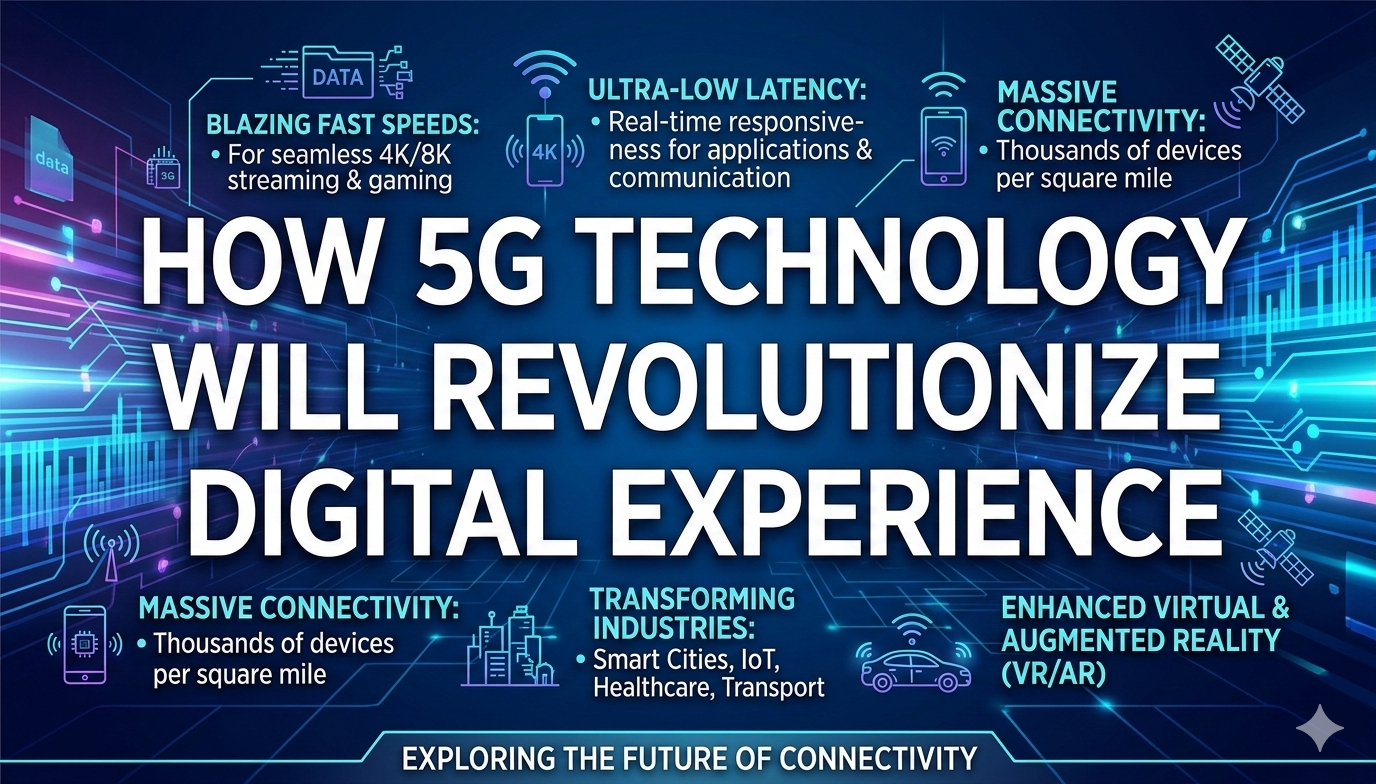
The arrival of 5G technology promises to significantly change the way we connect, communicate, and interact with the digital world. While 4G networks revolutionized mobile internet by making it faster and more reliable, 5G is set to take things to the next level. With speeds up to 100 times faster than 4G, ultra-low latency, and the ability to connect more devices simultaneously, 5G is poised to unlock new possibilities across industries and daily life.
5G technology is more than just a faster internet connection it’s a fundamental shift in how we interact with technology. It will enhance everything from mobile experiences to smart cities, healthcare, and entertainment. As 5G becomes more widely available, it will have a profound impact on the digital landscape, driving innovation and improving efficiency.
A key example of this is the way content creation is evolving. Whether you’re a business professional, a marketer, or a content creator, 5G will enable faster uploads, smoother video streaming, and real-time collaboration. For instance, bg remove tools will work even more efficiently, allowing creators to quickly produce high-quality visuals, such as removing backgrounds from images in seconds, which is essential in fast-paced digital environments.
Faster Speeds, Enhanced Connectivity
The most obvious benefit of 5G is the massive increase in internet speed. While 4G allowed for faster mobile data, 5G is exponentially faster. With peak speeds up to 10 Gbps, users will be able to download large files, stream high-definition content, and engage in data-intensive activities with almost no delay. This will particularly benefit industries that require large-scale data transfer, such as video production, gaming, and virtual reality (VR).
For consumers, 5G means seamless experiences. Mobile gaming will be smoother with less lag, video calls will feel more like in-person conversations, and downloading heavy files on the go will be a breeze. The increased speed will also help facilitate innovations in other areas like augmented reality (AR) and 3D video streaming, allowing these technologies to become more mainstream.
Low Latency for Real-Time Interaction
One of the most exciting features of 5G technology is its ultra-low latency. Latency refers to the delay between sending and receiving data over a network, and 5G promises to drastically reduce this lag, down to just a few milliseconds. This means that real-time communication will become nearly instantaneous.
For industries like telemedicine, this will be a game-changer. Doctors will be able to perform remote surgeries with real-time precision, using robotic arms and tools that require minimal delay. In gaming, the reduced latency will make online multiplayer games far more responsive, enhancing the user experience. The enhanced connectivity will also allow for more seamless video conferencing and collaboration, enabling remote teams to work together as if they were in the same room.
The Internet of Things (IoT) Revolution
One of the most significant changes that 5G will bring is its ability to support a massive number of connected devices simultaneously. As the Internet of Things (IoT) continues to grow, 5G will be able to handle the enormous influx of data from smart devices, sensors, and wearables. While 4G networks could connect a few thousand devices per square kilometer, 5G will be able to connect up to 1 million devices in the same space, making it the ideal network for IoT.
This capability will support the development of smart cities, where everything from traffic lights to waste management systems will be connected and monitored in real-time. In the home, smart devices like refrigerators, thermostats, and security cameras will be more responsive, and their integration will be more seamless. For industries, 5G-enabled IoT will lead to smarter factories, predictive maintenance, and improved supply chain management.
Revolutionizing Healthcare and Remote Care
5G technology will also have a transformative impact on healthcare, particularly in the realm of remote care and telemedicine. The combination of ultra-low latency and high-speed data transfer will enable more effective remote monitoring, diagnosis, and treatment. Doctors will be able to consult with patients in real-time, conduct virtual examinations, and even perform remote surgeries using robotic-assisted tools.
5G’s ability to handle vast amounts of data from wearables and other medical devices will also allow for continuous, real-time health monitoring. This will be especially useful for patients with chronic conditions, enabling doctors to track vital signs, adjust treatment plans, and intervene when necessary without the need for frequent in-person visits.
Additionally, the high-speed data transfer will improve access to medical research, allowing for faster sharing of data and breakthroughs. This could accelerate the development of treatments and improve healthcare outcomes globally.
Empowering Innovation in Autonomous Vehicles
5G technology will be integral to the development of autonomous vehicles. With its low latency and high-speed capabilities, 5G will enable vehicles to communicate with each other, traffic signals, and infrastructure in real-time. This communication is essential for autonomous driving, allowing vehicles to make quick decisions based on real-time data.
For example, a self-driving car will be able to receive real-time updates on road conditions, traffic patterns, and other vehicles, allowing it to adjust its route and speed accordingly. This level of connectivity will make autonomous vehicles safer, more efficient, and more reliable, paving the way for mass adoption of self-driving cars in the near future.
Transforming Entertainment and Media
5G will also revolutionize the entertainment and media industries. With the increased speed and low latency, streaming high-definition and 4K videos will become more accessible, even on mobile devices. The reduced lag will make live broadcasts, virtual concerts, and interactive events more engaging and immersive.
Furthermore, 5G’s ability to handle massive data transfers will support the growth of immersive experiences like augmented and virtual reality. These technologies will become more mainstream, enabling consumers to experience entertainment in entirely new ways. Whether it’s watching sports in virtual stadiums or participating in interactive gaming, 5G will enable new forms of media consumption.
Conclusion
5G technology is not just an upgrade to mobile networks it’s a technological revolution that will fundamentally change the way we interact with the digital world. With faster speeds, low latency, and the ability to connect millions of devices, 5G will enhance everything from mobile gaming and streaming to healthcare and autonomous vehicles.
As the rollout of 5G continues, its transformative effects will be felt across industries, economies, and our daily lives. Embracing 5G will unlock a new era of digital experiences, where connectivity, speed, and innovation are taken to levels never before imagined.